
Mission Bend Resident Lookup Roles
Mission Bend is a Census-designated place that crosses Harris and Fort Bend Counties, not an incorporated city with one clerk or one resident roll. A record must first be tied to the county that keeps it. County appraisal data can identify an owner of record, a mailing field, a property location, and a legal description. A clerk index can identify a grantor, grantee, or recorded instrument. A court portal can identify a party and case role. These are distinct roles, and none alone establishes current occupancy.
| Record | What it can confirm | Official keeper | Access path |
|---|---|---|---|
| Appraisal roll | Property interest, situs, mailing, and parcel details | Harris Central Appraisal District or Fort Bend CAD | Public search, subject to protected fields |
| Recorded property index | Instrument parties, date, legal description, and document reference | Harris County Clerk or Fort Bend County Clerk | Index and image or copy route |
| Court case index | Party role, case number, filing, events, and available documents | County court custodian | County-specific public portal or written search |
| Voter route | Only status, precinct, district, or polling details displayed | County election system or Texas SOS | Public lookup with confidentiality limits |
| Vital record | A qualifying event or verification under Texas rules | Local registrar or Texas DSHS | Qualified-requestor procedure |
Use the property and deed route when the starting point is an address. Use a court or voter route only after identifying the county and the question being checked. A name match is a lead, not a conclusion. The county, date range, middle initial, former name, subdivision, parcel key, and a second source help separate people who share a name.
Mission Bend Two-County Lookup
The Mission Bend label can lead to records in either county. Postal wording does not settle the issue. The Census boundary, county parcel map, subdivision section, and legal description are stronger checks. On the Harris side, start with Harris Central Appraisal District, Harris GIS, and the County Clerk real-property index. On the Fort Bend side, use Fort Bend Central Appraisal District, Fort Bend Interactive Public Mapping, and the County Clerk official-public-record route.
Keep the durable parcel key with every result. Harris uses items such as an account number and map facet. Fort Bend can return a Quick Ref ID, geographic ID, account ID, subdivision, or lot and block. Mailing and situs fields can differ for legitimate reasons, and neither confirms a household. If an association certificate or legal description reaches both counties, search both clerk indexes and label the county on each instrument.
Note: A postal city is not proof that an address is inside the Census place or that a record belongs to one county.
Mission Bend Court Lookup Fields
For the Fort Bend side, Fort Bend Tyler public access separates probate, civil and family, criminal, and court-calendar areas. Civil and probate searches accept case, party, attorney, or date filed. Criminal searches can use case, defendant, citation, attorney, or date filed. Soundex broadens a name search, while an asterisk acts as a wildcard. The portal does not allow Soundex and wildcard together.
The Fort Bend Tyler public-access portal separates the case and calendar search routes before a party-name result is reviewed.
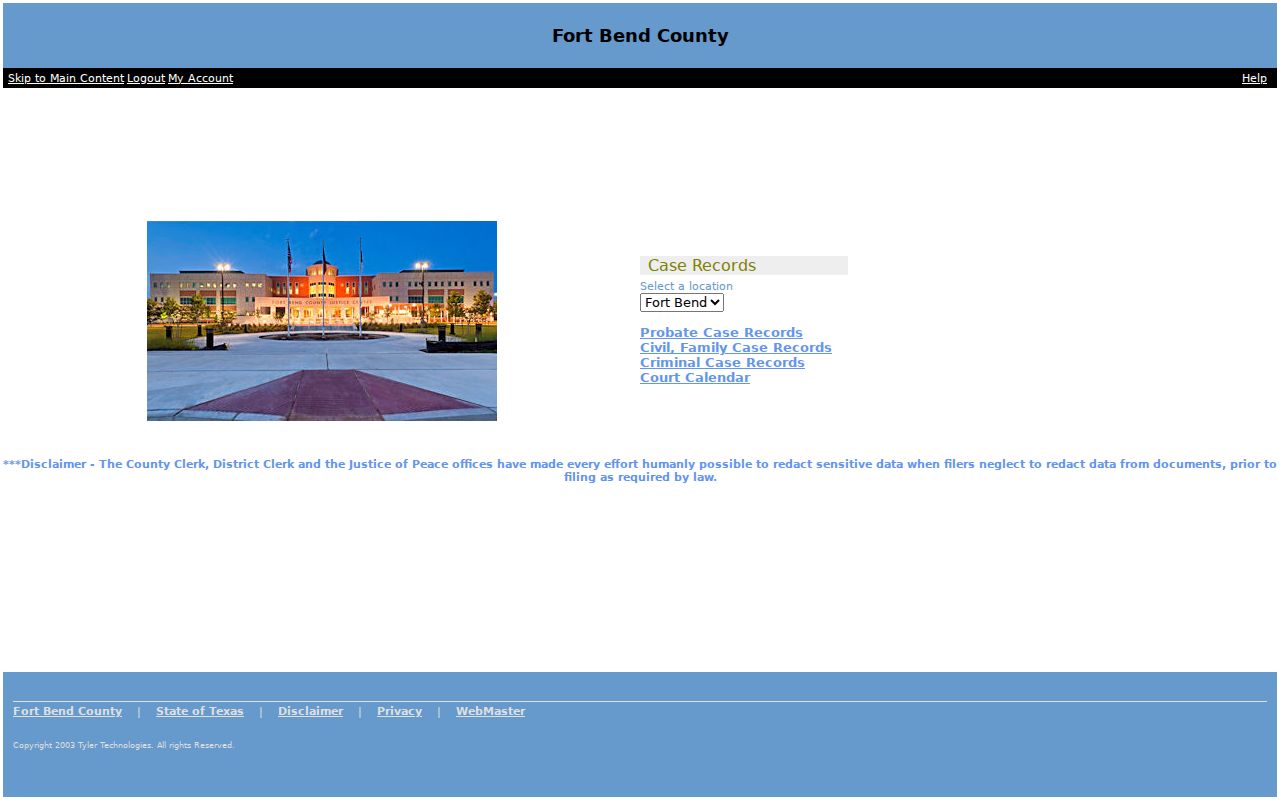
Its county-specific tabs help select the proper case type, but they do not extend a result to the Harris side of Mission Bend.
Harris-side district cases use the Harris District Clerk public search, which requires a free registered login. Party Inquiry accepts party name, party role, filed-date range, case status, court type, and case or offense type. It is a Harris County system, not a search of federal, other-county, justice-of-the-peace, or municipal matters. A missing result should be stated only as not located in that portal.
| Result field | What to preserve |
|---|---|
| Case number | The portal's unique case reference for a later custodian check |
| Party role | The displayed role rather than a general label such as resident |
| Filing and event dates | The date range searched and any displayed event wording |
| Case status or disposition | Only the exact portal status, with no inference from an allegation |
| Image access | Whether an image is available, restricted, or absent from the result |
The Harris District Clerk search screen shows the party, role, date, status, court-type, and case-type filters that must stay attached to any result note.
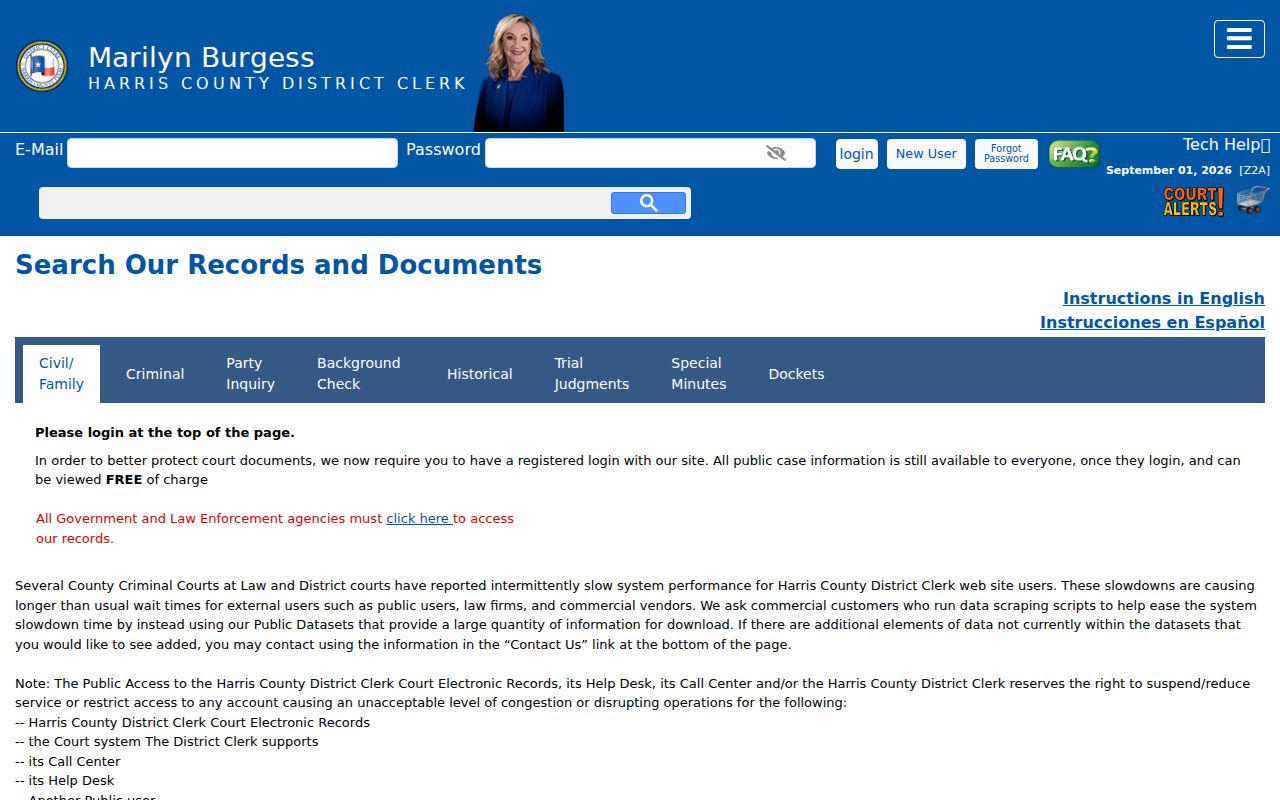
Those filters help narrow a public case index, but they do not turn a same-name result into a confirmed Mission Bend address.
Verifying a Mission Bend Resident
To look up a resident carefully, anchor the name to a dated record before comparing other systems. Start with the correct county parcel or address route, then retain the account or geographic identifier and the legal description. Use the relevant clerk index to see whether an instrument ties the same name to that parcel. A court result, voter result, credential, or historical directory entry may add context, but each carries its own scope and date.
- Normalize the known address with USPS and determine the Harris or Fort Bend county side through parcel or GIS information.
- Save the appraisal account or geographic ID, tax year, situs field, mailing field, and legal description without assuming the owner lives there.
- Search the matching county clerk index by grantor, grantee, subdivision, lot and block, or instrument number, then compare the document date and role.
- Check a county court or voter route only within its stated scope, and record the portal, search mode, date range, and result wording.
- Request a custodian-held copy when a public index lacks the needed nonexempt record, rather than filling the gap from an unofficial source.
- Docket
- A court's running list of filings, settings, and events in one case.
- Index and image
- An index lists searchable record fields; an image is the underlying document when the custodian makes it available.
- Certified copy
- A copy issued and certified by the custodian, distinct from an online index entry or an informal view.
Mission Bend Voter Lookup Limits
Harris County's voter search has Current Registrations and Pending Registrations tabs, a criterion selector, and a text field. Its related verification and registration route has fields for name, address, apartment, city, state, ZIP, and certificate number. The public notice says the site does not provide Social Security number, driver-license or ID number, date of birth, telephone number, or protected address. Results must be limited to the status, precinct, district, or polling detail actually displayed.
Fort Bend uses a separate voter inquiry form with a search-method selector, VUID, first and last name, date of birth, and CAPTCHA. A session failure or unmatched CAPTCHA is not a finding that a person is unregistered. When county jurisdiction is uncertain, the Texas Secretary of State voter lookup is a cross-county route, but it has separate privacy and freshness rules.
The Harris voter-search page visibly separates current and pending registration paths and warns that protected personal fields are not public.
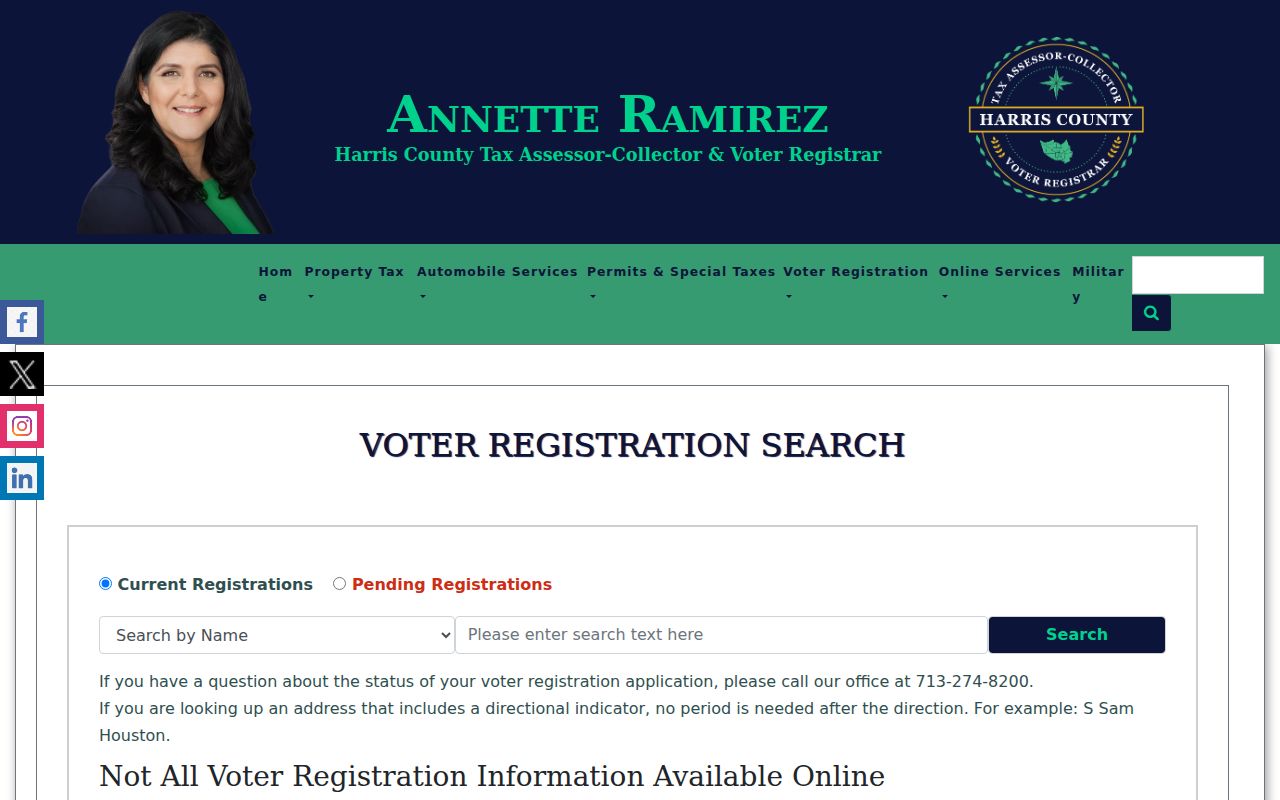
The absence of a public address or other field can reflect statutory confidentiality, not a reason to search around a protected person.
Note: Texas voter identifiers and protected residences remain confidential even when a general registration result is publicly visible.
Texas Vital Records for Mission Bend
Vital records can confirm an event only through the correct access route. Mission Bend has no municipal registrar identified in the official research. The event county matters, not simply the person's address. Texas DSHS lists qualified requestors for restricted records, while Texas Government Code Section 552.115 makes birth records public after 75 years and death records after 25 years. Marriage and divorce verifications are not the same thing as certified underlying records.
Texas OVRA's order system handles birth and death certificates plus birth, death, marriage, and divorce verifications. It requires an adult requestor, record and identity details, eligibility, payment, and delivery information. Most orders are stated to take 20 to 25 business days and are nonrefundable. Choose the form and product that fit the event and qualifying relationship.
The OVRA order route presents record type, identity, eligibility, payment, and delivery as separate steps.
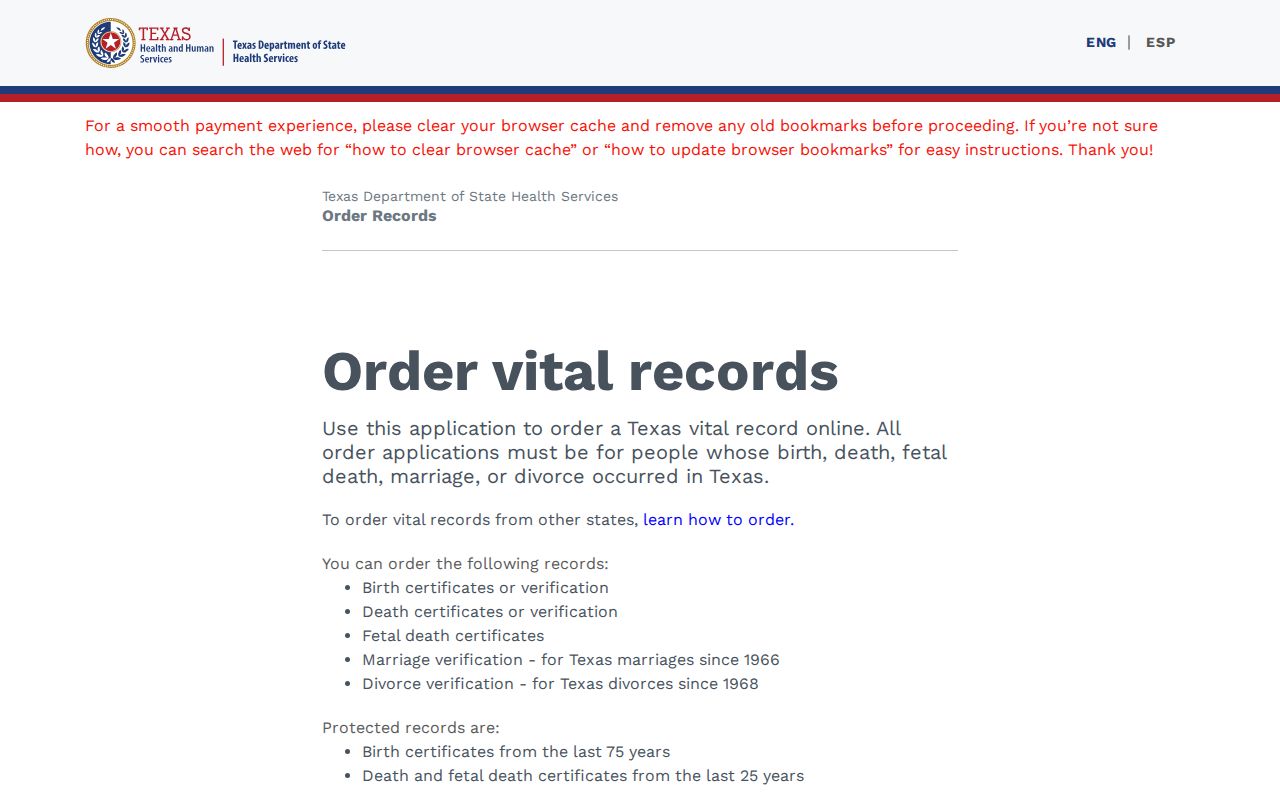
A verification letter can return limited event information, while a certified record follows stricter access rules. Neither should be used to expose a protected person.
Mission Bend Records Request Route
When an official index does not expose a needed record, use the custodian's request route. The Texas Public Information Act, Government Code Chapter 552, requires a written request that reasonably describes the records. Identify the county, office, record type, date range, address or parcel identifier, known name, case or instrument number, and preferred delivery. Ask for electronic copies of nonexempt portions when appropriate.
A custodian may ask for clarification, charge permitted costs, provide an estimate, redact confidential material, or seek an Attorney General ruling. Fort Bend provides public-information request paths for both the Sheriff and CAD. Retain the acknowledgment, clarification, cost estimate, redaction explanation, and final response. A portal's technical-help address is not necessarily the records custodian.
Note: A written request should seek a defined record from its custodian, not an open-ended collection of personal information.
Mission Bend Resident Lookup Limits
Public access has firm boundaries. Texas voter systems suppress sensitive identifiers and protected residences. Texas confidentiality programs can use a substitute mailing address or remove a participant from ordinary county display. Tax Code protections also cover qualifying residential information, and appraisal portals restrict some residential images and details. Do not use a parcel, voter, court, or family record to reconstruct the location of a protected person.
Keep the smallest useful record trail: agency, record type, county, date, public identifier, source URL, and the role actually shown. If a result is sealed, expunged, juvenile, confidential, or redacted, preserve only the access limitation. A person listed as a deed grantee, appraisal owner, court party, voter, or obituary subject should not be collapsed into a claim of present residence.
A historical name finding may need more context. The Mission Bend city directories collection is the better route for dated directory and library sources, rather than treating an older entry as a current address.