
Mission Bend City Directory Collections
Mission Bend is a Census-designated place that crosses Harris and Fort Bend Counties. It has no municipal government, city clerk, or city archive. That fact shapes the historical lookup trail. County and regional collections, rather than a city hall shelf, hold the useful material. A postal city label can also differ from the community name, so preserve the county, address form, collection name, and date beside every entry. The Houston collection is especially useful for regional surname and institutional history, while Fort Bend repositories supply local archival context.
| Collection | Years | Where held | Access |
|---|---|---|---|
| Houston digitized directories | 1866 through 1923 | Houston Public Library digital collection | Browse and search online |
| Houston city-directory holdings | Through 1986 | Houston Public Library reference holdings | Repository reference route |
| Later Houston holdings | 1980 to 1982, 1984, and 1986 | Texas State Library | Compare holdings by year |
| Fort Bend local-history sources | Varies by item | George Memorial Library and Historical Commission | Online, onsite, or by request |
Mission Bend was established around 1980. Earlier Houston volumes are therefore regional context, not direct proof that a person lived in a Mission Bend subdivision. A missing volume is also not proof that no directory was published. Compare the Houston and State Library holdings before treating a gap as final.
The Texas State Historical Association profile supplies the Mission Bend community context behind that collection boundary.

The profile helps date the community before a researcher assigns a regional directory entry to Mission Bend.
Mission Bend Without a Municipal Archive
Directory evidence cannot be treated as municipal residency data because no such municipal office was identified. The Census boundary is statistical, not a parcel-title line. A Mission Bend address can require Harris County records or Fort Bend County records, and a Houston, Richmond, or Sugar Land postal label does not settle that question. Use the Census map for the community boundary, then use county CAD and GIS records for the parcel side.
The practical handoff is clear. Harris County and Fort Bend County clerks hold recorded instruments; their appraisal and GIS systems identify parcel context; libraries and historical archives provide the older narrative sources. GMBAC has a broader civic boundary and an association inventory, but it is not a government custodian or a complete household list. Keep a civic map, a county parcel source, and an archival source distinct in any research note.
Community material can still use the Mission Bend name even when the legal address reads Houston or Richmond. Search the exact legal name, subdivision section, and county rather than assuming the community name names a public office. The Census boundary map is the boundary reference, county CAD and GIS systems are parcel references, and USPS supplies the postal label. Each answer belongs in a separate field of the research note.
Note: Record the county and source type with every Mission Bend directory finding so a postal label is never mistaken for jurisdiction.
Mission Bend Collections at George Memorial
For Mission Bend family history, George Memorial Library’s Genealogy & Local History Department is the primary local gateway. Its Rosenberg Historical Research Department focuses on Fort Bend and surrounding counties. The stated resources include newspapers, census indexes, local histories, vertical files, microfilm, obituary material, onsite reference help, and possible interlibrary-loan support. Ask for a specific surname, street, subdivision section, newspaper issue, cemetery, or date range. A precise request gives staff a usable starting point.
The department can add context that a directory alone cannot provide. Fort Bend newspapers reach from 1911 forward in the in-house collection, alongside several older regional newspaper runs. The material is a collection clue, not a promise that every name or address appears. Preserve the reel, issue, page, and collection name when a finding is located. That makes a Mission Bend research trail reproducible.
The library’s local-history page shows the reference collection route used for Mission Bend historical companion research.
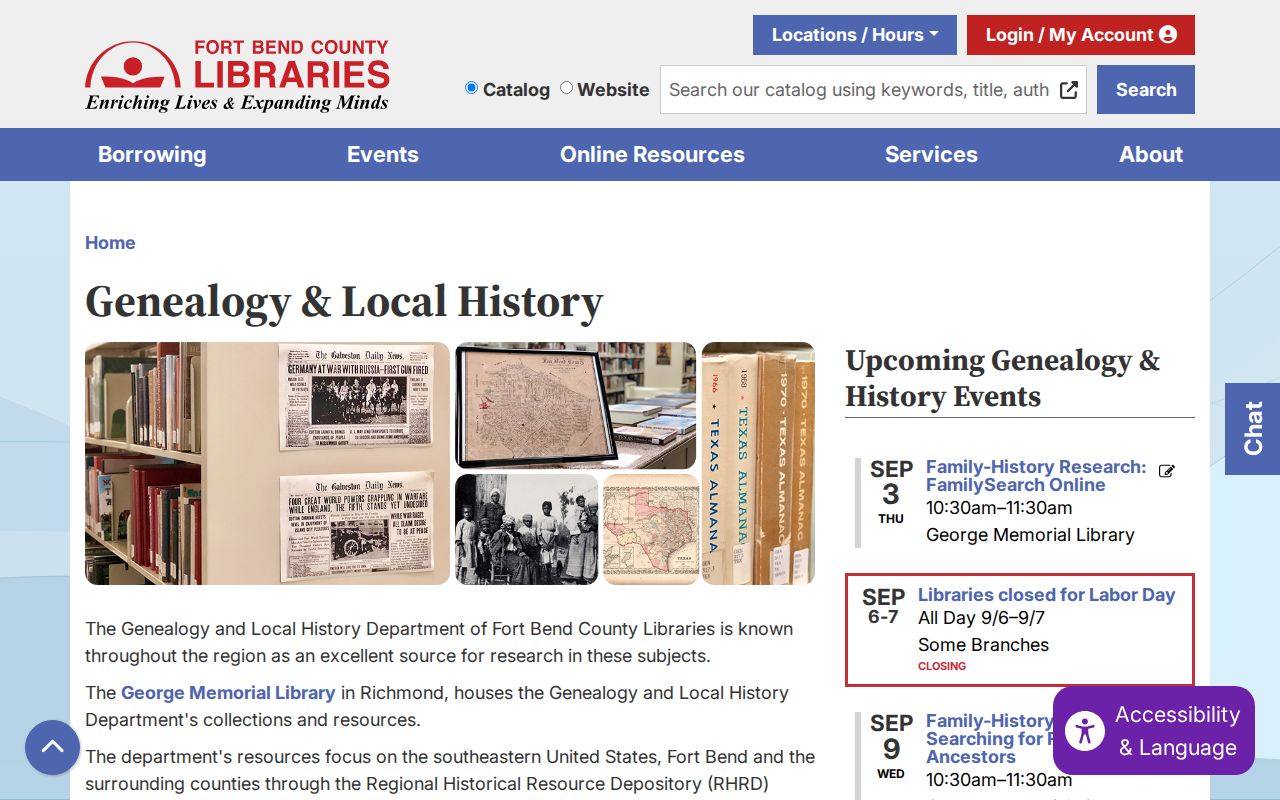
The library is a useful handoff when a Mission Bend directory lead needs a microfilm, newspaper, census-index, or vertical-file check.
Mission Bend Directories Online
Houston Public Library’s digitized directory collection begins in 1866 and makes volumes through 1923 available online. It supports searches for regional surnames, businesses, churches, and institutions. It does not turn early Houston entries into Mission Bend occupancy evidence. Mission Bend and its subdivisions postdate those early volumes, so use them to establish regional background or a family’s earlier location before checking later, dated sources.
Houston reference material identifies directory holdings through 1986, and the Texas State Library city-directory holdings fill selected later years. Compare repository holdings before assuming the online run is complete. If the relevant volume is not digitized, note whether the next route is library access, an archive appointment, microfilm, or a request to staff.
The digitized Houston directory collection is the source for this online collection view.
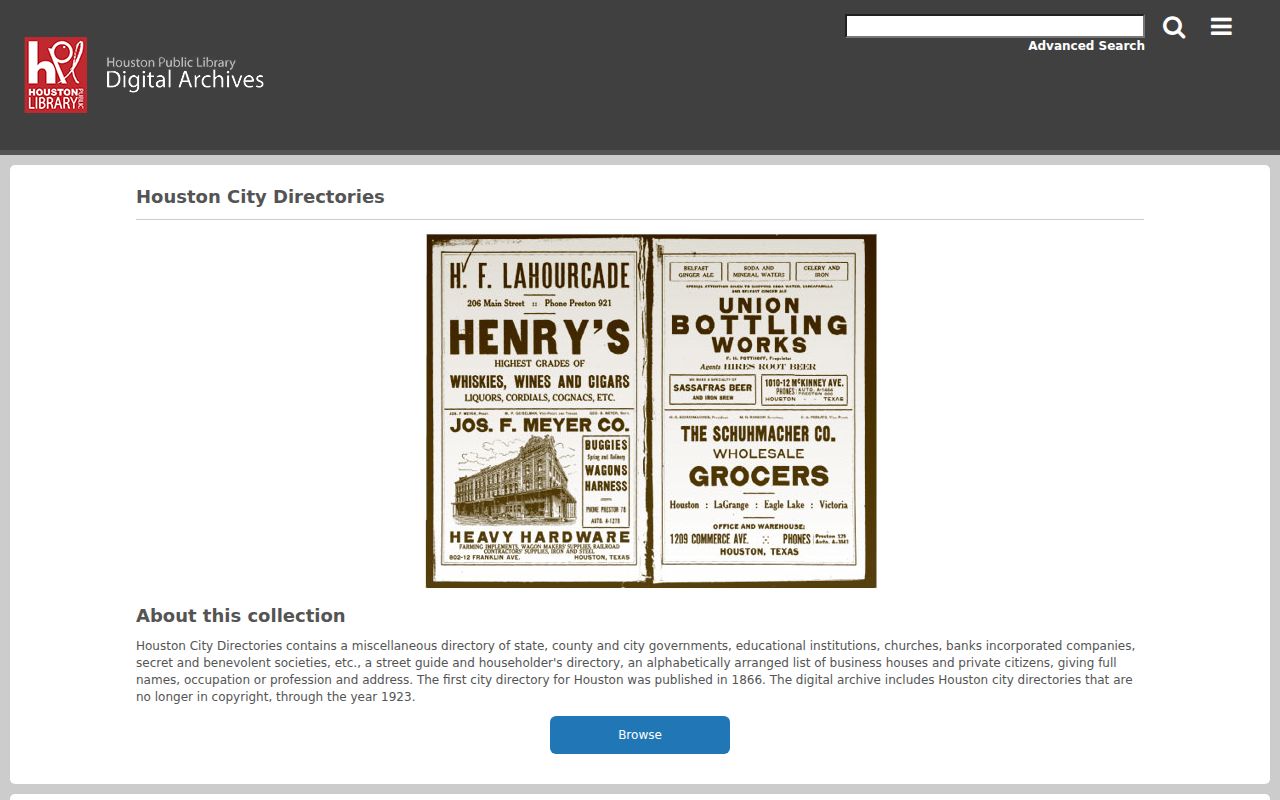
The online collection is best used as a dated regional source, then paired with a Mission Bend-era parcel, plat, library, or county record.
Read a Mission Bend Directory Entry
A directory entry identifies a resident or contact, not necessarily the owner of a property. HPL cautions that omissions and errors occur. Pre-1912 volumes were not cross-listed by address, while later street and avenue guides can help locate an address. Before drawing a conclusion, record the volume, year, page, street spelling, and geographic scope. A name match should be checked against a deed, probate file, obituary, census index, or another dated source that fits the same person and place.
| Name as printed | Preserve initials, spelling, and any alternate form rather than silently normalizing it. |
|---|---|
| Address or street guide | Shows the printed location for that volume, subject to the collection’s coverage and errors. |
| Entry role | May identify a resident, contact, business, church, or institution rather than an owner. |
| Volume details | Year, page, street spelling, and geographic scope make the finding checkable later. |
- Criss-cross directory
- A directory arranged by address or street, rather than only by a person or business name.
- Householder index
- A name-oriented listing that helps identify the household or contact associated with an entry.
- Abbreviation key
- The volume’s guide to its shortened labels; consult it before interpreting any entry notation.
Note: Photograph or transcribe the abbreviation key and title page with a Mission Bend directory entry to retain its original meaning.
Mission Bend Development-Era Cutoff
Mission Bend’s late-twentieth-century development is a valuable date check. TSHA places its establishment by 1980, and the research record describes residential growth linked to Houston expansion in the early 1970s. That means an older Houston directory or Sanborn sheet can offer regional history without documenting a Mission Bend subdivision that did not yet exist. Start a property-specific chronology with a dated plat, deed, appraisal record, or later directory address.
No official Mission Bend-specific Sanborn sheet was located. Houston Sanborn material remains regional context only. For a Mission Bend address, use the stable legal description, subdivision section, lot and block, plat reference, or recorded instrument to bridge an older naming question. A street-only match is weak when postal wording and subdivision development changed.
Trace Mission Bend Directories by Year
Use a dated sequence, not a single entry, for family history. A first appearance can be a lead, a later address can show a move, and a disappearance can reflect an omission, a new address, a death, or a change in the collection’s scope. Match each entry to the exact volume and then compare it with a census index, obituary, probate record, deed, or newspaper item that shares the same date range and geography.
- Find the closest available volume for the surname, address, or institution.
- Record the year, page, spelling, printed address, and the collection’s geographic scope.
- Check the next available year for a matching or changed entry, without assuming every year survives.
- Pair the sequence with a census index, obituary, deed, or county archive record that fits the same timeframe.
- Keep the result as a dated historical observation unless another source establishes a stronger connection.
For current address-keyed research, use the county systems rather than a historic volume. The Mission Bend street directory follows the parcel and recorded-instrument route for that different question.
Mission Bend Historical Companion Records
The Fort Bend Historical Commission archive offers categories for court and census records, burial, deed, probate, tax assessment, and Bible records. Begin with a category before a broad keyword search, then save the category, subcategory, historical period, archive number, and access mode. A search result is a lead. Its original context and date still need review.
Fort Bend Libraries’ obituary research supports partial names, date fields, wildcards, keywords, and Boolean searching, but the database is not complete. Cemetery material, newspaper issues, and probate files can help explain a dated directory finding without turning archival evidence into a claim about a living person. The Fort Bend County Info Index Search is another discovery path, provided the underlying county custodian is identified before a result is cited.
Historical preservation is distributed among county clerks, the District Clerk Historical Documents Room, the Historical Commission, George Memorial Library, Houston collections, newspapers, and the Library of Congress. Access can be online, onsite, on microfilm, by appointment, or by request. Preserve that access mode with the title, repository, year, page or archive number, URL, and a brief relevance note. It explains how another researcher can check the same Mission Bend finding.
Fort Bend Libraries’ public-record index route is shown here as a source-level discovery tool.
The source can point to a custodian or collection, while the original county or archival record supplies the evidence to preserve.
Note: Keep archival history separate from current-person claims, especially when a record might concern a protected living person.